
From FinOps to ITFM: Our Journey and the Era of Cloud+

Updated: Jan 16
The cloud has become the standard operating model for many organizations. Either workloads have been moved from traditional data centers to the public cloud, or companies are cloud-native from the very beginning. As a result, cloud cost management and with it FinOps has become a central element of how IT is financially steered. FinOps has evolved from a nice-to-have into a necessity and is now a non-negotiable part of how successful organizations manage cloud spending and connect usage to real business value.
As FinOps practices mature into the walk and early run stages, cloud teams often reach a point where cost transparency and optimization in the cloud are no longer the main challenge. Costs are under control, savings are being realized, and spending can be explained in terms of business value to a broader set of stakeholders. At this stage, a common question emerges:
If FinOps works so well in the cloud, can similar ideas help us create more cost transparency across the rest of IT?
This is often where the scope starts to expand. Teams begin by applying FinOps thinking to adjacent areas such as license management or data center cost allocation and gradually develop a broader view of the entire IT cost structure. FinOps remains the foundation, but its principles are extended into IT Financial Management to bring the same transparency, ownership, and value focus to technology costs beyond the cloud.
This journey is not unique to single FinOps teams but reflects a broader shift within the FinOps community as a whole. The FinOps Foundation’s State of FinOps 2025 report describes this development as the “Era of Cloud+”, a shift that is also reflected in the 2025 updates to the FinOps Framework. Together, they highlight several important changes:
Expanded Principles: The core idea of everyone taking ownership of their cloud spend has evolved into taking ownership of technology usage overall, with the goal of maximizing business value
Growing Scope: The FinOps Framework now explicitly includes SaaS and data center scopes alongside public cloud, with many practitioners also covering licensing, private cloud, and AI-related costs
Increased Collaboration: The State of FinOps 2025 survey shows that FinOps teams are now working more closely than ever with neighboring disciplines like ITFM
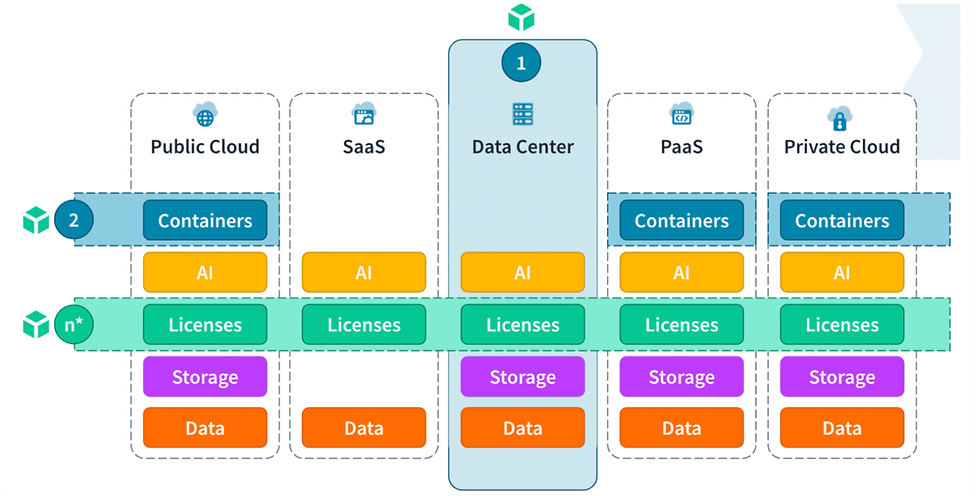
Extened scope of the updated 2025 FinOps Framework (Source: https://www.finops.org/insights/2025-finops-framework/)
While expanding beyond pure cloud costs through a cloud+ approach makes sense from a strategic point of view, it also brings a clear reality check. Outside the cloud’s structured and data-rich environment, many established IT financial processes still rely heavily on spreadsheets, long email chains, and manual coordination. Long contract durations and complex internal decision paths add further friction and slow down decision-making.
Defining the Disciplines: FinOps vs. ITFM
Planning horizons are longer and alignment across stakeholders takes more effort. Coming from an environment where costs can be traced and allocated with a high level of precision, this shift required a fundamental change in perspective from our end. It became evident that our FinOps mindset alone is not sufficient to manage the full breadth of IT costs.
That was the starting point of our deeper move into IT Financial Management (ITFM), not as a replacement for FinOps, but as a necessary extension of it.
Defining the Disciplines: FinOps vs. ITFM
FinOps and ITFM are not competing approaches and were never meant to replace one another. Both aim to help understand where technology spend occurs and what value it delivers to the business.
IT Financial Management (ITFM) focuses on the full picture of IT spend, including infrastructure, software, services, labor, and long-term commitments across the entire organization. The perspective is typically top-down, driven by central IT, finance, and leadership
FinOps focuses on cloud costs and the day-to-day decisions that influence them. Even though its scope is expanding in the Cloud+ era, it remains strongly bottom-up, with teams close to the technology taking responsibility for how resources are used
Despite the difference in scope, they share a significant common ground in addressing practical questions like cost allocation, handling shared platforms, budgeting, forecasting, and using unit-based views to explain cost and value to the business.
Feature | ITFM | FinOps |
Scope | Full IT Spend (On-Prem, Cloud, Labor, Software, Facilities, etc.) | Cloud Costs and technology usage |
Rhythm/Speed | Slow, Strategic (Monthly, Quarterly, Annual cycles) | Fast, Operational (Daily/Weekly checks and adjustments) |
Technology Ownership | Centralized (IT Leadership, Finance, Procurement) | Decentralized (Engineers, Product Owners, Finance) |
Data Granularity | Aggregated data from different systems, often monthly or quarterly, based on contracts and allocations | High granularity with per-second or exact usage cost data |
In short, ITFM looks at technology costs from a wider, company-level perspective. It supports investment decisions and long-term planning across the whole IT landscape. FinOps, on the other hand, stays much closer to day-to-day operations as it builds on detailed, near real-time data.
It is also important to be clear about where FinOps draws its boundaries when it comes to total cost of ownership (TCO). FinOps primarily focuses on cloud consumption and does not cover many cost areas outside the cloud bill, such as labor costs for FinOps teams themselves or operational expenses like electricity and office space. As a result, these costs are not part of FinOps showback or chargeback models in most organizations. Instead, they are managed through monthly, quarterly, or annual budgeting cycles led by controlling or finance teams and remain largely invisible to engineering teams in a FinOps context.
With the move into the Cloud+ era and the inclusion of SaaS and licensing, some of these gaps are starting to close. However, this remains an important consideration when extending FinOps beyond pure cloud usage.
At the end of the day, both FinOps and ITFM aim for the same outcome: better decisions about technology spend. The difference lies in their scope, their speed, and how financial responsibility is applied in practice.
Key learnings from mature FinOps setups
Real-time data creates real ownership
FinOps is built on timely and granular data. Public cloud platforms provide detailed usage and cost data down to the second or to the kilobyte used. This creates fast feedback loops where optimization is not an annual initiative, but a continuous process. Engineering teams can immediately see how architectural decisions affect costs, turning cost responsibility from a distant accounting concept into a practical, daily business.
Optimization levers are concrete and measurable
In day-to-day FinOps work, cloud cost savings usually come down to two clear and measurable levers:
Usage optimization, such as rightsizing resources, shutting down unused environments, or scheduling workloads so they only run when needed
Price optimization, for example by buying Reservations and Savings Plans, or by negotiating better commercial terms
Both levers can be measured almost immediately. Their impact is easy to validate and track over time. It can also be clearly communicated across the organization. This is one of the reasons why FinOps works so well in practice.
An important aspect here is that these optimization levers look very similar across all major public cloud providers. Whether it’s AWS, Azure, or Google Cloud, the underlying mechanics are largely the same. This allows us to apply a standardized FinOps approach across hyperscalers instead of reinventing the wheel for each platform.
Long-term, sustainable savings don’t come from technical optimizations alone. They depend just as much on people. Strong community building and intentional change management are needed to embed the FinOps mindset into everyday work. Only when teams genuinely take ownership of their cloud usage and understand the cost impact of their decisions does FinOps create lasting value beyond short-term wins.
Teams work with shared responsibility
FinOps is fundamentally based on a shared responsibility model. Product teams own their cloud budgets. Engineering teams own the architecture. Finance tracks performance using granular cost data. This cross-functional collaboration, working from a shared data foundation, empowers decision-making across the entire organization, speeding up optimization dramatically.
The ITFM Reality Check
Moving from a cloud-first FinOps mindset into the broader ITFM landscape came with a number of practical lessons. While many principles translate, they do not transfer one-to-one. These five lessons shaped how we approach technology financial management today.
Unit economics become harder to apply outside the cloud
In FinOps, unit economics are relatively easy to calculate because the underlying data is granular and close to real usage. Metrics like cost per compute hour, API call, or transaction can be derived with high accuracy, and teams can directly see how technical decisions affect these numbers.
Outside the cloud, this becomes much more challenging. Usage data is often incomplete, spread across multiple systems, or indirect by nature. Licenses are purchased in bulk, servers are shared by multiple applications, and services are consumed as part of bundles. Defining units such as cost per employee, cost per product, or cost per business capability therefore requires clear allocation rules, assumptions, and alignment across teams.
For ITFM, this means unit economics still matter, but they require a different mindset. Chasing perfect accuracy down to the last cent is usually neither realistic nor helpful. What matters more is being consistent, being clear about assumptions, and having the right governance in place so everyone understands how the numbers are derived and how they should be used.
Cloud cost is part of TCO, but not the other way around
FinOps focuses primarily on cloud consumption costs. These costs are an important part of the picture, but they represent only one component of the total cost of ownership (TCO). ITFM takes a broader view, factoring in labor, software licenses, maintenance contracts, facilities, depreciation, and external services. This wider perspective makes it possible to understand the true end-to-end cost of running a service.
One key lesson we learned is that optimizing cloud spend alone does not automatically result in the lowest TCO. A technically cheaper cloud setup can introduce additional operational complexity and increase support effort. At the same time, slightly higher cloud costs can sometimes reduce expenses elsewhere.
A simple example illustrates this well: Moving to a cheaper, self-managed database might lower infrastructure costs on paper. In reality, it often requires more engineering time for maintenance, patching, and troubleshooting, which drives up operational and staffing costs. Choosing a slightly more expensive managed database service increases cloud spend, but can significantly reduce support effort and license needs, leading to a lower total cost overall.
FinOps offers strong control over cloud consumption. ITFM adds the necessary context to assess whether a decision makes sense when viewed across the full lifecycle and total cost of a service.
Effective cost management depends on combining short-term and long-term time horizons
One of our key takeaways was that effective financial steering needs the two time-horizons working together. FinOps operates at high speed. It helps spot inefficiencies early and enables teams to react quickly, often within days or weeks. ITFM works on a slower cadence and translates these operational improvements into budgets, forecasts, and long-term investment decisions.
The goal is not to choose one over the other, but to connect them. FinOps provides the fast feedback loop, while ITFM ensures that short-term optimizations are reflected in longer-term enterprise planning. When FinOps insights consistently flow into ITFM processes, operational savings turn into sustainable financial outcomes rather than isolated one-off wins. One practical example is making well-founded decisions about which workloads should move to the cloud and where a hybrid on-prem and cloud setup makes more sense.
Showback and chargeback outside of the cloud require a lot more thinking
In In the cloud, showback and chargeback are comparatively straightforward. Most cloud costs can be allocated using tags, which makes it easy to link spend directly to usage. Teams can quickly see what they consume and what it costs, often with a high level of accuracy and very little manual effort.
Outside the cloud, this becomes significantly more complex. Cost data typically comes from many different sources such as CMDBs, contract and procurement systems, asset databases, or even spreadsheets. In many cases, it is not clearly defined who is using which service, or there is no reliable usage data at all. Compared to the cloud, this lack of transparency means that much more preparatory work is required before meaningful showback or chargeback is even possible.
To overcome this, ITFM requires deliberate effort. This includes cleaning up service catalogs, defining ownership, integrating data sources, and sometimes making pragmatic assumptions where data is incomplete. Tools like Apptio or Flexera can help, but the real work lies in establishing processes and accountability.
The lesson here is that FinOps techniques can significantly improve the speed and quality of showback and chargeback, but they need to be adapted and supported by ITFM structures to work at scale.
The shift from FinOps to ITFM requires a broader scope and perspective
FinOps requires an inward-looking perspective. It focuses on architectural choices, utilization levels, and technical efficiency. ITFM requires an outward-looking perspective. They focus on business capabilities, vendor relationships, contracts, and enterprise-wide governance.
These perspectives involve different stakeholders and different skill sets. An engineer or FinOps practitioner is well equipped to analyze a cloud bill or optimize resource usage. Renegotiating an outsourcing contract or consolidating vendors requires procurement, finance, and senior IT leadership, often over much longer time horizons.
We also encountered cultural challenges. In traditional environments, teams are often not used to being charged internally. Statements like “the servers are already paid for” are common. Addressing this requires clear communication, trust-building, and a shared understanding of why this transparency matters and how the whole company can benefit from that.
Our key takeaway is that managing technology costs effectively requires the right lens for each cost area. FinOps and ITFM are not competing approaches, but complementary perspectives that together enable better decisions across the entire IT landscape.
Summary
If you are reaching the limits of FinOps by looking beyond cloud costs, the core ideas you learned there still matter. Transparency, clear ownership, and data-driven decisions become even more important once costs extend into less structured areas like data centers, software licenses, and external services.
Applying FinOps thinking to IT Financial Management helps bring consistency to the full IT cost landscape. It creates clearer accountability, better cost transparency, and more grounded decisions across cloud, infrastructure, software, and services. The outcome is not just stronger cloud cost control, but a more sustainable way to steer technology spend across the entire organization.


Comments